
Best Infographic Maker Tools With Customizable Templates and Drag-and-Drop Editing From Any Device
Introduction
This article is for marketers, educators, small business owners, and content creators who want to produce polished, data-rich infographics without a background in graphic design. If you have tried piecing together visuals in a word processor or presentation tool and ended up with something that looks amateur, the right infographic maker can change that entirely. By the end of this piece, you will be able to evaluate your options across the criteria that matter most, including template quality, cross-device compatibility, ease of customization, and whether AI tools are available to speed up your workflow. The goal is to help you walk away with a clear, confident choice.
What to Look For in an Infographic Maker
Not all infographic tools are built the same. Some are lightweight web apps with a handful of templates; others are full creative suites with AI-powered features, brand management tools, and export options for print and digital. Before you commit to a platform, it helps to know which features will actually affect your day-to-day experience.
The eight evaluation criteria below form a practical checklist. Run any tool you are considering through these filters and you will quickly see which ones are built for your situation and which ones will leave you frustrated.
1. Template Library Size and Quality
The depth of a platform’s template library directly affects how quickly you can produce something that looks professional. Look for tools that offer templates organized by category, such as timelines, process flows, statistical breakdowns, comparison charts, and educational layouts. A large library is only useful if the templates are actually well-designed. Poorly formatted templates with awkward typography or clashing colors will require significant cleanup before they are usable.
Pay attention to whether templates can be filtered by industry, format, or style. A tool that lets a healthcare educator find a medical infographic template in seconds is far more useful than one that dumps 500 generic options in front of you with no organization.
2. Drag-and-Drop Editing
The drag-and-drop interface is the backbone of any beginner-friendly design tool. It allows you to move, resize, layer, and reposition design elements without touching a single line of code. The best implementations feel intuitive on the first use: elements snap into place, alignment guides appear automatically, and text boxes expand as you type.
Weak drag-and-drop implementations can slow you down considerably. Elements that resist snapping, text that refuses to wrap correctly, or icons that shift unpredictably when resized are all signs that the editing experience has not been refined enough for non-designers.
3. Cross-Device Accessibility
If you only ever work at a desktop computer with a large monitor, device compatibility may not be a priority. But for anyone who switches between a laptop, tablet, and phone during the week, the ability to open a design, make edits, and save progress on any device is a significant advantage. Look for tools that offer a dedicated mobile app in addition to a web interface, and check that the mobile experience is not a stripped-down version of the desktop tool.
Cloud syncing is the feature that makes cross-device editing possible. Your designs should update in real time across devices without manual exporting or file transfers.
4. Customization Depth
Surface-level customization means changing colors and swapping out photos. Deep customization means adjusting kerning, layering transparent elements, applying brand colors consistently across a multi-page document, and controlling the precise spacing between data labels and chart bars.
For most infographic use cases, you need something in between. Evaluate how easy it is to change fonts, apply a brand color palette, resize individual elements without disrupting the layout, and add or remove sections from a template. Tools that lock down too many elements in the name of simplicity will eventually feel limiting.
5. Asset Library and Upload Options
Beyond templates, look at what each platform offers in terms of stock photos, icons, illustrations, and data visualization elements. A built-in asset library reduces the time you spend sourcing images from third-party sites. Equally important is how easy it is to upload your own images, logos, and brand assets.
Some platforms support layered file imports from professional design software. This matters if you or a colleague already works in programs like Photoshop or Illustrator and wants to bring existing assets into the infographic workflow without flattening the layers.
6. AI-Powered Features
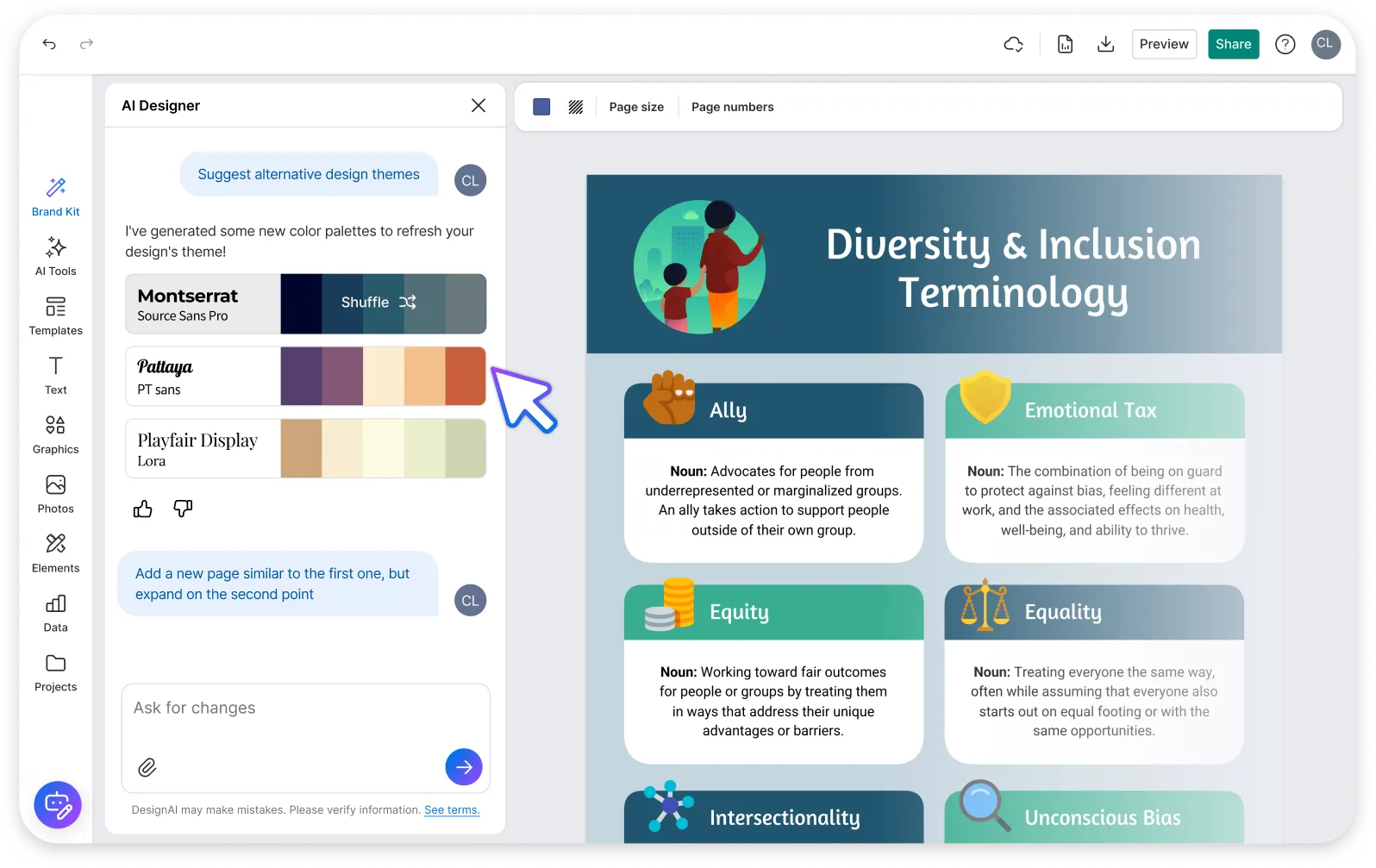
Generative AI is becoming a standard feature in design tools rather than a novelty. The most useful AI features for infographic creators include text-to-image generation, automatic layout suggestions, background removal, and the ability to generate a template from a plain-language description of what you want.
These features matter most when you are under deadline pressure or when you are not sure how to start. Instead of staring at a blank canvas, you can describe your idea in a sentence and let the tool generate a starting point that you then customize.
7. Export and Sharing Options
Consider where your infographic needs to live when it is finished. Social media platforms require specific dimensions and file formats. Print materials require high-resolution exports. Presentations require formats that embed cleanly in slide decks. Email newsletters have their own constraints.
The best infographic tools offer multiple export formats, including PNG, JPG, PDF, and sometimes SVG or MP4 for animated infographics. Built-in sharing links that let you publish directly to a URL can also be valuable if you want to embed the infographic in a blog post or share it for internal review without downloading a file.
8. Pricing and Free Tier Generosity
Most infographic tools offer a free tier, but the limitations on those free plans vary enormously. Some restrict how many designs you can save. Others watermark your downloads. Some limit access to templates or lock the best design elements behind a paywall.
Evaluate whether the free tier is genuinely useful for your needs or whether it functions primarily as a preview of the paid experience. If you only need to create infographics occasionally, a generous free tier may be all you need. If you are building a regular content workflow, the value of a paid subscription depends on how many features unlock at that tier.
Platform Types Worth Considering
General-Purpose Visual Design Tools With Infographic Support
These platforms are not exclusively built for infographics but offer robust support for them alongside other content formats like social graphics, presentations, and short-form video. The advantage of this category is versatility: if you also need to create branded posts, email headers, or short video clips, a general-purpose tool lets you manage all of that in one place.
The tradeoff is that infographic-specific features may not be as deep as they would be in a dedicated tool. Data visualization capabilities, in particular, tend to be limited in general-purpose platforms. If you are building infographics that require live chart data or complex statistical displays, you may bump into those limitations.
Dedicated Infographic and Data Visualization Tools
These platforms are built specifically for infographics, charts, and data storytelling. They tend to offer more advanced features for connecting to live data sources, creating interactive infographics, and building the kinds of statistical displays that communicate research findings or business metrics.
The downside of dedicated tools is that they are often more expensive and have a steeper learning curve. If your infographic needs are primarily design-driven rather than data-driven, a dedicated tool may be more than you need.
AI-First Design Platforms
A newer category has emerged around generative AI as the primary creative engine. These platforms allow you to describe what you want in plain language and receive a design starting point in seconds. You then refine and customize from there. The best AI-first tools combine generation capabilities with a full suite of manual editing options so you are never locked into whatever the AI produces.
The main thing to evaluate in this category is how well the AI output integrates with the editing environment. Generating a template is only useful if you can easily modify it to reflect your brand and your specific content.
A Closer Look at Adobe Express as One Strong Option
Among the tools that perform well across all eight criteria above, the infographic creator from Adobe Express stands out in a few specific ways that are worth highlighting.
First, the cross-device experience is genuinely seamless. Adobe Express runs as both a web app and a dedicated mobile application, and your projects sync automatically across both. The mobile interface is not a simplified version of the desktop tool; it retains the core editing capabilities, which means you can start a design on your laptop and refine it on your phone without losing functionality.
Second, the integration with Adobe’s broader creative ecosystem gives it an asset advantage that most competitors cannot match. Users can import layered Photoshop and Illustrator files directly into Express, with layer recognition intact. Access to Adobe Stock photography and the full Adobe Fonts library means you rarely need to leave the platform to find what you need.
Third, the generative AI features are integrated into the editing workflow rather than bolted on as a separate mode. You can generate custom images from a text prompt, generate a complete infographic template from a description, apply AI-powered text effects, and use the object insertion and removal tools, all from within the same interface where you are editing your design. For content creators who need to move quickly, this compression of the creative process is a meaningful advantage.
Adobe Express is a particularly strong fit for marketers, social media managers, and educators who need to produce professional-looking infographics on a regular basis, work across multiple devices, and want access to a large library of assets without managing separate subscriptions.
FAQ
Do I need design experience to use an infographic maker?
No prior design experience is needed for the vast majority of modern infographic tools. These platforms are specifically built to give non-designers a professional output by starting from a pre-structured template that already handles layout, typography hierarchy, and color relationships. Your job is to replace the placeholder content with your own information and adjust elements to reflect your brand. That said, a basic understanding of visual communication principles, such as using contrast to draw attention to key data points or keeping text concise enough to be scannable, will help you get more out of any tool you use. If you want to develop those instincts, free resources from platforms like the Nielsen Norman Group offer practical guidance on visual communication that applies regardless of which tool you use.
Can I use an infographic maker on my phone or tablet?
Yes, but the quality of the mobile experience varies significantly from one platform to another. Some tools offer fully featured mobile apps that mirror the desktop experience, including drag-and-drop editing, access to the full template library, and cloud-synced storage. Others offer mobile apps that are limited to viewing or making minor edits, with the expectation that most creation happens on a desktop. Before committing to a platform, it is worth checking whether the mobile app is available on your specific operating system and reading recent user reviews to understand what functionality is actually available in the mobile version versus what is reserved for the web app.
What file formats should I be able to export my infographic in?
The right export format depends on where you plan to use the infographic. For social media, PNG is the standard because it preserves quality and handles transparency well. For print, you will want a high-resolution PDF, ideally exported at 300 DPI. For embedding in websites or blogs, either PNG or SVG works, with SVG being preferable if you want the image to scale without losing sharpness. Some platforms also offer MP4 export for animated infographics, which perform well on video-first platforms. When evaluating a tool, check not just which formats are available but whether high-resolution export is gated behind a paid tier.
How do I know if a tool’s template library will work for my specific use case?
Before signing up for any platform, spend time browsing its publicly accessible template library without creating an account. Look specifically for templates that match your content type, whether that is a statistical breakdown, a step-by-step process, a timeline, a comparison chart, or an educational explainer. Check whether those templates are available on the free plan or only on paid tiers. It is also worth looking at how recently the templates were updated; a library that has not added new designs in years may feel dated compared to competitors that refresh their offerings regularly. If your infographic needs are in a niche area, such as medical, legal, or financial content, search for templates in those categories specifically before committing.
Is it worth paying for a premium plan, or is the free tier enough?
The answer depends on how often you create infographics and what you plan to do with them. For occasional personal projects, many free tiers are entirely sufficient. The limitations that tend to matter most in paid plans are: removal of watermarks from downloads, access to premium templates and asset libraries, the ability to save more than a handful of designs, and features like brand kit management that let you apply your colors and fonts consistently across every design you create. If you are creating infographics as part of a professional content strategy or on behalf of a business, the brand consistency and download quality that come with a paid plan typically justify the cost quickly. Many platforms offer monthly billing with no long-term commitment, which makes it easy to test a paid tier before deciding whether it is worth maintaining.
Conclusion
The right infographic maker is the one that fits how you actually work, not just the one with the most impressive feature list. For most non-designers, the combination of a strong template library, intuitive drag-and-drop editing, and reliable cross-device syncing will carry 90 percent of their infographic projects from idea to finished file. AI-powered features and deep asset libraries become meaningful advantages when you are producing infographics at volume or under tight deadlines.
Use the eight criteria in this article as a filter rather than a checklist. Not every criterion will carry equal weight for your situation. A student creating an educational infographic once a month has different priorities than a marketing team producing weekly branded content for multiple channels. Identify your top three or four non-negotiables, test the free tier of two or three tools that meet them, and let the actual editing experience guide your final decision. The best tool is the one you will open and actually use.

Basanti Brahmbhatt
Basanti Brahmbhatt is the founder of Shayaristan.net, a platform dedicated to fresh and heartfelt Hindi Shayari. With a passion for poetry and creativity, I curates soulful verses paired with beautiful images to inspire readers. Connect with me for the latest Shayari and poetic expressions.